Thursday, January 24, 2013

Atelier - Part 2

Hi there!

OK, so I'm back to finish off my exploration of the gastronomic safari that is dinner at Atelier. Please keep in mind that I'm working 3 months after the fact and a lot of this is coming purely from incomplete notes.

10th Plate - "Appletini, Appletini, Appletini?" - photo by kira_generika

And now, dessert time! The first course "Appletini, Appletini, Appletini?" (I have no idea what the heck the name is all about) was a celebration of apples, obviously, and the chef was clearly have one helluva party with them! I'll try my best to explain all that was going on here. There were pieces of poached apple, an apple and sorrel sauce, apple cider foam, apple-sour cream cake, as well as a hazelnut and white chocolate ice cream, a chocolate caramel "paint" (I think) and pieces of dehydrated chocolate mousse. This last component was definitely my personal favourite on this plate; it was like sponge toffee, but in chocolate form - super crunchy, rich and tasty. I also quite enjoyed the marriage of the apple flavours with the white chocolate-hazelnut ice cream. Very bright and fun, but still pretty damn rich.

11th dish - (Your Name Twice), Pumpkin Eater
Next up, the requisite pumpkin dessert. Kari was wary, not being a pumpkin fan, but needn't have been. This course was quite an enjoyable departure from the standard, and overbearing, pumpkin pie flavour profile. The dish was made up of a chestnut-pumpkin cookie, a pumpkin mostarda (a kind of sweet pickle), a coconut-ginger sorbet, something that appeared to be a disk of pumpkin pie filling (but not sure what they actually called it), homemade granola (which was a bit peppery, in an awesome way), a coconut macaroon, coffee paint, and a bunch of other stuff! I really liked how they played the "heaviness" of traditional pumpkin flavourings with bright and refreshing flavours like coconut and ginger.


Special birthday course - Shattered Dreams

Hey, it's my birthday! So, for an added bonus, I get cake! Although in this case it's shortbread with buttercream icing frozen in liquid nitrogen and smashed into pieces by our server. Hence the name "Shattered Dreams". I discovered a couple of interesting things through this "bonus" dish: first, liquid nitrogen is kinda epically cool, and two, not sure I like the texture it creates in baked goods... It was damned tasty, but it felt a little like chewing on fibreglass. Maybe Atelier's version of the birthday bumps?

Last dish - A Mangoes into a Bar...

And finally, the last dessert, A Mangoes into a Bar (ba-dum-bump). It consisted of (so far as I can remember) pieces of fresh mango, cardamom ice cream, funnel cake, crushed pistachio bits and dried mango soaked in vermouth. While this sounds like a lot of big, kick-in-the-face flavours, it was actually a nice light way to end the night and cleanse the palette. The flavours were fresh and bright and it was a perfect way to end the night. Probably my favourite dessert of the night (although the dehydrated chocolate mousse bits in the Appletini dessert win best dessert element).

So there you have it, a remarkable foodie experience - definitely a fascinating and delicious birthday treat!

Now, if restaurants were simply about food, then this would be in the running for top meal ever. Unfortunately, service does play a role and I found the snobbishness of our server didn't mesh well with such fun and playful dishes. He should of at least laughed at the bad jokes!

I'm curious if there wasn't an intentional "good cop-bad cop" kind of dynamic going on since the sommelier was very easy-going and down-to-earth (which aren't really the qualities one expects in a sommelier), in contrast to our reservedly smug server.

But really, that is my only complaint, and it's minor in the grand scheme of things. It would have also been nice to have gotten the details of the plates in writing, but I'm nitpicking out of blogger laziness. Lord knows trying to scribble the notes while the server described each dish was pretty damn challenging.

As for the dining experience, I would, should money accommodate, try Atelier again, but not until they did a total menu revamp. I'd very much like to see how such a culinary production evolves with the seasons.

In the end, was it worth the hundreds of dollars in output? I say yes, if only for the incredible variety, creativity and boldness of the food. Not being a dessert person, however, I found myself wishing for more meat, less sweet (especially when the dessert courses were larger than many of the dinner courses). But the desserts were pretty remarkable and I would not want to take away from them.

So that pretty much wraps up the gastro-journey that is a meal at Atelier! Kudos again to the chefs!

Wednesday, January 2, 2013

A Toast to My Hometown's Better Eateries - Atelier - Part 1

Hi there!

Yep, it's time for another account of an over-the-top culinary experience. The occasion? My 38th birthday! Now, the occasion (Oct. 16) has long since passed, but I had trouble getting all the pics and write-ups organized. Also, what I'm writing here are memories of impressions of flavours I experienced nearly 3 months ago, so accuracy might not be dead on. Then again, those flavours I DO remember and can describe in detail should help give you an idea of just how *good* this food was.

Note: After trying to get this posted in one go for months now, I decided that splitting it up into two posts was the way to go. After all, we are talking about 14 total courses here! So, the first part will cover the 10 savoury courses and the second part will cover dessert and my overall impression. Essentially, this is one big post split in two mostly to salvage my brain and your eyes.

So let's get to it!

As a birthday present, I asked Kari if she could treat me to a culinary adventure at one of Ottawa's somewhat well-kept secrets in dining, Atelier Restaurant. The brainchild of chef/owner Marc Lepine, Atelier provides 12-plate tasting extravaganzas, and that's it! Each meal (escapade? tasting safari?) takes about 3 hours and there are optional wine pairings as well as an extensive by-the-bottle wine list. The cuisine can best be described as "evil and tasty genius" with lots of neat-o techniques like sous-vide and molecular gastronomy being put into place, which I appreciated, having seen many of these interesting techniques on TV, but they aren't really commonly accessible for the average foodie in Ottawa.

Atelier is a food snob's paradise and they know it. The Soviet-style "no need for a sign" exterior makes a clear statement that if you don't know how to find the place, maybe you shouldn't have bothered. But, that being said, the interior is quite warm and intimate.

Very austere decor on the outside

So, as we were sat down, we were given our wine pairing list and menu:

Wine pairing

The menu - details to be provided!
Our server was quite soft-spoken and, unfortunately, a bit aloof. Which, considering the pedigree the establishment is trying to put together, is understandable, but not always the best way to engage a people-person like Kari. Oh well... Let's get on with the food!

First up were a series of fun little amuse-bouches. Just from this initial display, I knew it was going to be a fun night by my tongue and tummy!


A plethora of "amuse-bouches"
In the shot glass was a combination of 25 spices designed to replicate the flavour of a gin and tonic. it was definitely a wake-up call for the palette.

Next was fried chicken skin (in the centre of the plate) with little dots of jalapeno and plum purée. What's to say? It's fried chicken skin! Bag that stuff and sell it at the local Mac's Milk!

Next was a one-bite tuna tartare (just to the front and right of the shot glass) with passion fruit and jerk spices. This was an interesting dish as it metamorphosized from a sort of muddied bite into an explosion of bright fruit flavour and delicious fish with a spicy kick ,but not too much.

Next up was a little chickpea and yogurt "doodle" on date purée. This was another magical transformation as the flavours came together to remind me of an incredible one-bite samosa.

Finally, in the beakers at the left was a roasted garlic soup rimmed with eggplant calzone spices. It was a little tricky drinking the soup, but it was pretty delicious (hard to miss with roasted garlic!). I don't think I got the spices to mix with the soup the way the kitchen had intended, I just remember a burst of tomato goodness.

OK, now that the freebies were done with, out came the wine and the first of many plates.


1st dish - Undercover Salmon

The "Undercover Salmon" was called so because the fish under the piece of bread, which was actually a pumpernickel chip. Glad to see the chefs share my respect for the flavour of pumpernickel, a highly underrated bread, frankly...

As for the dish itself, it was really fun as you had to crack the chip to get at the sockeye salmon tartare beneath, which was flavoured with lemon sambuca (I think) and tarragon. Very subtle flavours to accompany the salmon which was delicious. The dish was rounded out with a quail egg, edible flowers and a finger pepper. There was a beautiful moment of decadence as I made sure I got a nice piece of fish, chip and the quail egg in my gob all at once. Soooooo gooooood!

2nd dish - Mini Mozza

The second dish was called "Mini Mozza" and centred around a pair of fresh mozzarella balls (snicker here). This was an interesting version of a Caprese salad, with cherry tomato, marinated eggplant, edible flowers, fresh basil and a milk barley foam serving as the dressing (maybe? A lot of this stuff is out of my league for interpretation). Then there were the interesting mad scientist touches of broccoli and heart of palm purées (the green and beige "jellies" on the plate). On top of that was a sprinkling of dehydrated olive which added a nice rich salty finish.

But all of these elements were bowing at the feet of the meat element: pieces of fried pork jowl, which were basically like the bacon God made on the 7th day because He needed to outdo the previous 6 days work via pork. Yeah, that.


3rd dish - Liquid Orange Sticks

Dish 3 was called Liquid Orange Sticks and this was sort of the soup course for the evening. was built around carrot broth with chorizo, oyster plant and pickled Israeli couscous. There were other elements (the white powder was freeze-dried something) but I couldn't write all the details in time. That being said, the most memorable elements of this were the fantastic combo of the carrot soup with the chorizo (definitely something that I'll attempt to make in the future), and the pickled couscous, which was like little flavour grenades - a kind of sweet-and-sour Pop Rocks...


4th Plate - Black and Green (photo by kira_generika)

Next was Black and Green, the second of four fish/seafood dishes (which was quite the surprise for me, who never can get enough fish and seafood). This dish consisted of tempura halibut cheeks with squid ink alongside a garlic pistachio purée, a kind of whipped avocado, corn nuts(?) and slices of jalapeno peppers.

Really, the star here was the fish. It was delicate, flavourful and tender, with the tempura adding a crispy and greasy undertone. It was a fun little juxtaposition of refined and dirty. The purée added an extra dimension of flavour, but got a little lost next to the fish. I don't really even remember that rest of the elements.

But really, they could have just served the halibut cheeks naked on a plate and I would have been happy...


5th Plate - Tofulery

And the food just keeps on coming... Up next was the first plate that had me cocking an eyebrow. it was called "Tofulery" and as someone who generally keeps the bean curd at arms' length, I wasn't sure what to expect.

The dish consisted of smoked tofu in a dashi broth with soba noodles, porcini and lobster mushrooms, ginger and Chinese greens. There were probably more ingredients than that, but I didn't have time to write them down... (I'm still not sure if the the white stuff in the picture is egg or tofu!)

I needn't have worried about the tofu though, it was quite tasty! The whole thing tasted like a very high-end miso soup: salty, rich and warming. Not the best dish of the night, but possibly the nicest surprise.

6th Plate - Sebastien and Pinchy (photo by kira_generika)

And here we have the hands-down winning plate of the night: Sebastien and Pinchy, an homage to lobster.

This was a combination of crab salad and lemon-poached lobster meat with zucchini, celery, and spice cake, topped with brown butter and served on a reduced lobster stock.

Verdict? OH MY SWEET GOD, BEST PIECE OF LOBSTER EVER!!!!!!!! Which means that it's possibly the best bite of anything I've ever had in my life. I cannot give enough kudos to the kitchen team for this one. The lobster was tender, sweet, exquisitely balanced by the lemon and totally worked with the veggies. The spice cake wasn't necessary (as spice cake in savory dishes can be, this isn't the first time I've thought this) and I think I made sure to eat it apart from the lobster and crab salad for that very reason. Also, the crab seemed to be just a couple of degrees south of fresh. It was delicious, but it was a subtle bit funky.

Now, I would like to point out to the creative team that makes up the names of the plates at Atelier that Sebastien (from The Little Mermaid) and Pinchy (Homer Simpson's pet lobster) are BOTH lobsters, but we'll let it slide this time...

I seem to remember that once I'd finished this plate and had the corresponding crustacean foodgasm, I went outside for a smoke and to digest a little.

7th dish - Like a Sturgeon

Next up, more fish! Um, OK!!

I'd never had sturgeon before so I wasn't sure what to expect. Would it taste oily and "fishy"? Would it be super light and delicate like the halibut cheek had been? After all these plates, the flavours would need to be pretty bold to keep me from losing interest.

I was in luck, this tasted like fish should: delicate, but with pronounced flavour. In this case, the fish had a subtle bitterness that nicely went with the Moroccan spices in which it was seared.

Complimenting these flavours was a kind of chickpea/olive/apricot relish. The plate was also served with pieces of grilled (I think) artichoke, red pepper purée and a goat cheese/cauliflower foam. I found that the foam was a bit understated when eaten with the fish, but it was quite lovely on its own.

8th dish - Piggie Smalls

Well, I'll be damned, time for some mammal!

Next up was Piggie Smalls: Crazy porcine goodness with tons of extras. The plate consisted of sous-vide pork leg in some kind of rich tangy sauce with cherry tomatoes, artichoke purée, grated Gouda, garlic powder (but freshly-made magic cooking science garlic powder), chimichurri, slices of beet, charred corn and pickled chantrelle mushrooms served over a habanero "paint" on the plate. Basically it was a kind of Barbecue Salad with elements of Tex-Mex. REALLY tasty, if not revolutionary. The pork leg was cooked terrifically, with subtle hints of ham coming through even though it hadn't been cured or smoked.

The only "gaffe" was that I think the habanero paint had been painted on some time before serving, like maybe an hour or two! It was stuck, almost dried, on to the plate and as such I really wasn't able to incorporate it into the other flavours. That was really too bad, because I betcha it was DELICIOUS!

9th dish - Land of the Rising Bison
The last of the savory dishes was Land of the Rising Bison, consisting of pieces of grilled bison loin, kohlrabi slices with soymilk gel (the round tubular dealies), fennel, green bean tips, cashew tuile (the long thin pieces that look like crispy noodles), a cashew-coriander crumble, fermented green tea and cilantro oil.

By this dish, a little taste bud exhaustion had set in. Looking back, there are only a few elements that were able to etch themselves onto my palette so as to remember what it tasted like. The first was the bison itself: perfectly cooked and delicious, melt-in-your mouth tender. The juice from the meat mixed well into the fermented green tea pooling beneath it to make a remarkably unique jus. Second, the cashew tuile was wonderful, like candy, but paired well with the rest of the dish. Unfortunately, the rest of the plate was a bit more understated and as such was lost next to the flavour of the meat.


To be continued!

Saturday, December 22, 2012

Let's Get Nutty!

Hey howdy!

It's time to explore our inner Daffy Duck! Woo-woo-hoo-woo-hoo-woo-hoo! It's time to get nuts!


Daffy was funnier in the 40s when he was completely batsh** crazy!
 
Nuts are one of those awesome ingredients that somehow get overlooked a whole heckuvalot. We snack on them once in  a while, eat butterized forms of them on bread and watch our friends cradle their Epi-pens should they be allergic and in the vicinity of them.

But what is the real value of nuts? Well, nutritionally they're supposed to be rather good for you. They're full of protein and vitamins, making them an ideal meat replacement in most meals. But, they also can be a good ingredient in everyday cooking.

One of the more obvious examples where nuts are used to provide body and flavour is in pesto. Pesto is usually made using basil and pine nuts, but due to the prohibitive cost of pine nuts and their penchant to go stale fairly quickly, they aren't always the most logical of ingredients. Many basil pesto recipes I've seen specifically permit the omission of pine nuts.

Me, I figured I'd not even bother in the first place and use a cheaper (and maybe healthier?) alternative using almonds. And, to give it a much different, zingier flavour profile, I say let's go with cilantro instead of basil! Turns out, after some Internet research, that this isn't a terribly original idea, but what in cooking really is? It's still tasty, goldarnit!


Almond-Cilantro Pesto

Ingredients
 
- 1 cup cilantro leaves, cleaned and stemmed
- 1/4 cup raw almonds
- 1/2 tsp sumac powder (optional - sumac can be found at Middle Eastern grocers - it has a turmeric-like earthiness, but also a nice bitterness that enhances citrus flavours)
- 1 tsp lemon zest
- 1 tsp lemon juice
- salt and pepper to taste
- 1/2 tsp capers
- 2 tsp olive oil

Directions

- Combine all ingredients except oil together in a food processor.
- Pulse together adding a little bit of oil at a time, until all ingredients are well combined into a chunky paste.

Tasty, green and bright!

This is one of those highly functional recipes that can be used in many different ways. You can mix the pesto with other ingredients to make a tasty pasta dish, you can spread it on bread for a sandwich topping, you could even cobble together a salad dressing with the pesto as a base. It's also similar to chimichurri, which is an Argentine form of pesto used as a topping on steak.

Quick lunch - toast, pesto and cherry tomatoes

So, this is just one example of how to get nutty with your food. I'll be back soon with a post on using nuts as a meat substitute. Stay tuned!

'Till then, enjoy!

Saturday, November 24, 2012

Cooking with Beer

Hi there!

In a tip of the hat to the original "bachelor cook" concept upon which this blog was founded, I'd like to take a look at what has been an essential ingredient to my own cooking since the mid-90s: BEER! As I've discussed on numerous occasions in these "pages", beer has come into its own in recent years as more than just fuel for frat parties and football watching, with brewpubs like Mill Street who make their own beer and cook with it, and beer-themed restaurants like Brothers Beer Bistro that treat beer with the same respect as other "high end" restos treat wine.

But when it comes right down to it, my most primal memory of cooking with beer is standing over a frying pan with a piece of meat, pouring a bit of suds in the pan to add flavour and de-glaze. Heck, even when making a stir-fry I'd usually use beer as the cooking liquid/marinade (as seen in this archaic "Dude, Cook!" post). And of course, no chili is worth making unless it has a good whack of beer in it.

With the current resurgence of craft brewing in Canada, the ubiquitous so-called Pilsners (Blue, Canadian, etc.) are no longer the norm and there's all manner of different beers out there with unique flavour profiles. As a result, I like to try cooking with some of these more uncommonly flavoured beers.

Luckily, one can find all kinds of wonderfully quirky beers if one looks hard enough. It just so happens that, during wicked good times had at the Festibière de la Gatineau this past Summer, I learned of a speciality beer store deep in the heart of Gatineau called "Broue-ha-ha" ("broue" being French for, um, brew). It sells all kinds of Quebec microbrews and on my birthday I decided to ride out and pick up all kinds of different beers, one of which was Route des épices, which I'd had the pleasure of trying out back in February at Pain Béni in Quebec City. I figured the spicy, rich and peppery quality of the beer would make it fun to cook with, but I still needed to figure out what to make!
Well, luckily, inspiration abounds all the time in this wondrous life we all live. In this case, the fun play of the old Quebecer classic "Hot Chicken" that Kari enjoyed in rabbit form at Joe Beef a month earlier fit the bill perfectly. At first I was thinking I'd mostly follow the standard procedure, using chicken (albeit smoked) and toast and gravy. Ah, but I'd make the gravy using the skin and fat of the chicken, AND the beer! Beer gravy! Totally great idea!

So, with that in mind, it was off to the butcher!

And, of course, as soon as I walked in the door, my fickle mind sensed something even more interesting than chicken. There, quacking out to me, was a lovely duck breast, begging to be smoked. So, it was settled. I would brine and smoke the duck, but instead of searing the duck skin as per the "rules" of cooking duck, I'd trim the fat and skin off the meat before smoking it and use them as the base of my gravy.

With the duck happily brining, I had to come up with other ingredients to round out this happy meal. The "Hot Duck" would be served over toast and topped with peas and gravy as per normal, but I couldn't just eat that. It needed a side to go with it.

Well, traditionally "Hot Chicken" comes with fries, so why mess with tradition? Of course in my case, I'd make sweet potato fries and since I was going with a 'cooking with beer' theme and happened to notice bottles of Beau's Night-Märzen Oktoberfest Lager at the LCBO, I figured I'd whip up some sort of dipping sauce for the fries using the Night-Märzen. I also happened on a shop selling Irish cheddar, so it all pretty much came together quite naturally.


The all-important liquid ingredients in today's feast.


So, with recipes in brain and ingredients in hand, it was time to cook this mess of tasty up!

WARNING: There is nothing healthy about this. Except maybe the peas.


Smoked "Hot Duck" with "Route des épices" Beer Gravy

Ingredients

- 1-1 1/2 pound duck breast

- Trim the skin and fat off the duck breast and set aside in a ziploc in the fridge before brining. If I wasn't using the skin and fat for the gravy, I'd keep them on the duck to help retain moisture while smoking, but in this case the gravy is as much a centrepiece of the dish as the meat itself.

Brine

- 6 cups water
- 2 cups apple juice
- 1 cup kosher salt
- 1 cup brown sugar
- 2-3 bay leaves
- 1-2 cloves garlic, crushed or minced
- 1 tsp black peppercorns
- 1 tsp smoked paprika

- Whisk all ingredients together in a non-reactive container, ensuring salt and sugar are completely dissolved. Submerge duck breast into brine and ensure it stays submerged by covering with a small plate or other weight. Brine for around 12 hours.
- Once you remove the duck breast from the brine, rinse well in cold water and pat dry.

Brining does discolour the meat a little, but it'll look fine once smoked. The little pink area here is a spot where air got trapped under the plate, so that small patch didn't soak in the brine.

Smoking the Duck

Duck doesn't need a whole lot of smoking time, about 3-4 hours at 225-250 degrees Fahrenheit. I'd read quite a few posts complaining about how the exterior of the meat dries out too quickly when smoking, but I found that was not a problem after I wrapped the meat in foil for the final hour of smoking.

Now, while duck breast is generally supposed to be served medium-rare, with the middle being a deep purple colour, in this case the smoking process cooks the meat right through and since we're smothering it in gravy, the meat can be a little less rare and tender.

Keep the duck breast warm by wrapping in foil and keeping in a 200 degree F oven while making/finishing the gravy.

Gravy

Ingredients

- Skin and fat from duck breast (see above)
- 1 tsp unsalted butter
- 1/2 cup sliced button or cremini mushrooms
- 2 tbsp minced onion
- 1 tsp minced garlic
- 1 cup "Route des épices" beer
- pinch each of salt, pepper, rosemary, oregano and smoked paprika
- 1 tsp corn starch
- 2 tbsp water
- 1/2 cup maple syrup
- 1 tbsp molasses

- In a saucepan, melt butter and sauté mushrooms, garlic and onions for 10 minutes at medium-high heat.
- In another saucepan, render duck fat and skin on medium heat.
- Once fat has rendered, transfer mushrooms, garlic and onions into the duck fat. Before doing this, you might want to remove the cooked bits of skin. They get kind of chewy and don't really add anything to the gravy. I didn't do this and it didn't bother me, so it's up to you.
- Add beer and seasonings and cook down at medium heat for about 10-15 minutes.
- Combine corn starch and water to make a roux (thickener).
- Whisk in roux, stirring constantly and cook for another 10 minutes.
- Add maple syrup and molasses and cook for another 5 minutes. Remove from heat.


Bubblin' its way to tasty.

It was after adding the roux that I made an important discovery about cooking with strong, hops-forward beer: that stuff can be really bitter! My gravy, which I'd expected to be rich and delicious, was almost unpalatably bitter. So, what to do? Well, sweet is usually a counter to bitter, so to the Sweetener-mobile! I decided on the spot to add a good whack of maple syrup, which countered the bitterness well, but the gravy needed an extra push over the cliff, so I threw in molasses as well. This resulted in a sweeter-than-expected gravy, but how would it taste once I put it all together? We'll see!

Peas and Toast

- In the last 10 minutes of making gravy, toast two slices of dark rye/pumpernickel bread to desired toastiness.
- Steam 1 cup frozen peas in 1/2 cup boiling water for 4-5 minutes and drain.

Putting It All Together!

- Slice duck breast into about 1/3 cm thick pieces.
- Using two dinner plates, place a piece of toast on each plate.


Ready for a gravy bath!


- Next, ladle gravy over the toast and duck. Be generous.
- Finally, top with peas and serve!


Dinner time!

So, how was it? Well, kinda delicious! The duck was succulent and tender and is really freakin' good smoked! The gravy was a little more bitter than I'd have liked, but that was balanced by the maple and molasses to make all the flavours combine well, with a nice earthy undertone from the mushrooms. The peas added a fun crunch and burst of something resembling nutrition.

In the end, the addition of sweetness in the gravy actually made it better! As with most smoked meats, like ribs, a sweet sauce is a good counterbalance to the smoky/salty meat flavour. However, the beer choice was a bit of a dud. Next time, I'll use a much less hoppy beer. Maybe a mild stout?


Sweet Potato Fries with Irish Cheddar/Night-Märzen Dip


Fries

- 2-3 large sweet potatoes, cut into fries

- Preheat oven to 400 degrees Fahrenheit
- Rinse the potatoes in water and dry well. The Internet suggested I try coating them in corn starch to help make them crispy, but really, that was an unnecessary step.
- Spread sweet potatoes on a baking sheet and bake for 15 minutes, turning halfway through.

Dip

- 1/2 cup mayonnaise
- 1/2 cup grated Irish cheddar (or extra-old cheddar)
- 1 clove garlic, minced
- 1/2 cup Night-Märzen beer, or other flavourful Oktoberfest-style lager

- Mix all ingredients together and bake in oven-proof dish at 400 degrees Fahrenheit for about 8-10 minutes or until top is golden and bubbly.

Note to self, corn starch doth not crispier fries make...
 
In the case of the dip, the bitter flavour of the beer was a bit more subdued, but also worked really well with the sharpness of the cheddar and creaminess of the mayo. The fries were meh-ish, but really, what are fries but simply a vehicle for some sort of saucy, tasty goodness?

And there you have it, my experiment in cooking with more interesting beers. The end result wasn't quite what I was expecting, but it taught me some culinary adaptation skills and a lesson in ingredient selection. In this case, just because you love to drink a certain beer, doesn't mean it'll be the best for cooking.

Til next time, stay tasty San Diego!

Monday, November 5, 2012

The Pig in Autumn - Part 2

Hello again!

As seen in my first post on autumnal porcine indulgences, it's not hard to use pork in making some of the most tasty and comforting foodstuffs you might ever try. Last time we forgoed (forwent?) the oven in favour of the slow cooker. Today, it's all about the oven.

Our first foray will be into the traditional realm of the stew. Making stew isn't really all that complicated. You take a lot of tasty ingredients and cut 'em up, throw 'em in a pot, and cook that sumbitch down until it's thick, rich and delicious.

OK, there are some intricacies that might need clearing up...

It was a cold night and I wanted to really get into all the flavours I love in the Fall and somehow get them all in a pot together. I wanted pork, apples, parsnips, carrots and potatoes to come together in a hearty bowlful of good that would make my life full of happy.

After picking up a nice pork chop at my local butcher, I mosied over to the fruit and vegetable purveyor to get the rest of what I needed for the stew. Whilst I was there, I noticed a whole bunch of fennel bulbs that called out to me "uuuuuuuuse us in your steeeeeeeeeeeeew!" (because somehow fennel is haunted). So I bought one. Having never used fennel before, I wasn't sure what the heck to do with it, but luckily the ever-cheerful part-owner of Byward Fruit Market (Myriam?) was able to give me the skinny on how to use a fennel bulb.

Basically, you use the stalks for things like soups and stews and whatnot. You use the fronds like any other herb (for garnish or whatnot) and the main bulb can be grilled, fried, or eaten raw in salads. It also kicks butt in a stir-fry as I discovered a little while later...

For my purposes, I decided to use the stalks and fronds. The stalks look pretty much like celery once you slice them up. And the licoricy (is that a word?) flavour fennel imparts actually worked quite well in this case, which is good, because I was a smidge worried I was about to ruin a perfectly good stew.


So, without further ado, here's the recipe!

Apple-Fennel-Pork Stew

Ingredients

- 1 lb. boneless pork meat, cubed
- 1/4 cup unbleached flour
- 1 large onion, minced
- 4-5 cloves garlic, minced
- 2 tbsp olive oil
- 2-3 red skinned potatoes, diced (about 1 cm thick)
- 2-3 fennel stalks, sliced (about 1/2 cm thick)
- 2-3 celery stalks, sliced (about 1/2 cm thick)
- 3-4 carrots, peeled and sliced fairly thin (about 1/4 cm)
- 1-2 parsnips, peeled and sliced fairly thin (about 1/4 cm)
- 1-2 Cortland apples, diced (about 1 cm thick)
- 1-2 tomatoes, diced
- 1 cup lager (Creemore is my go-to cooking beer)
- 1 tsp fresh or dried thyme
- 1 tsp fresh or dried rosemary
- 1 tsp dried dill
- 1/2 tsp dried oregano
- 1/2 tsp smoked paprika
- 1 tsp salt (or to taste)
- 1 tsp black pepper
- pinch grated nutmeg
- juice of half a lemon
- fennel fronds for garnish

Directions

- Coat pork in flour, shaking off excess flour.
- Heat oil at bottom of a large pot
- Brown meat and sauté onions and garlic on medium-high for about 5-6 minutes.
- Stir in the rest of the ingredients, except the lemon juice, and cook on medium-low heat for about 45 minutes, until stew starts to thicken.
- Stir in lemon juice and cook for another 10 minutes or so.
- Serve garnished with fennel fronds.


Bubble, bubble, toil and OMNOMONOM...


The colours of Fall, in stew form

The verdict? A really interesting and comforting mix of flavours. The sweetness of the apple blended well with the more unique flavours of the fennel and parsnip, with the beer and pork adding a nice rich depth to the stew. This is perfect "eat with a hunk of bread after raking the leaves" kind of food.


Our next examination will be dirt simple, but it's one of the best foods around! You know and love their messy goodness. Give it up for rrrrrrrrrriiiiiibs!!!!!

Now, while ribs are generally considered a Summer treat, what's stopping us from making up a nice batch of them in the Fall? What? You don't feel like grilling? Well, who says ribs need to go on the grill? They don't even need to go on the smoker (not blasphemy, I swear!)

To be honest, baking your ribs is actually a much easier way to get super-tender, fall off the bone ribs than smoking. The moisture stays in much better and it's a damned site less effort. That being said, I will continue to stand by the virtues of smoker-over-oven for one reason, the most important reason: they taste better smoked.

But the comparative ease can't be ignored. The process is almost identical to smoking ribs, as per the last post on the subject.... First you brine the ribs. In this case, since I was using regular pork instead of wild boar, I made a different brine.

Baked Ribs

Brine (for about 2 lbs. of ribs)

- 8 cups water

- 1/4 cup kosher or sea salt
- 1/4 cup brown sugar
- 1 tsp. coriander seeds
- 1 tsp. garlic powder
- 1 tsp black pepper
- 1-2 tbsp ground mix of guajllo, chipotle and mulato chilis
- 1 tsp ground ginger
- 4 bay leaves

So, after you brine the ribs for about 8 hours, rub them. I used pretty much the same rub as I did in June's post:

Rub


- 2 cups brown sugar
- 3-4 arbol chilis
- 1 guajillo chili
- 2-3 allspice berries
- 1 tsp. salt
- 3-4 star anise pieces (NOT the whole pod, just the seeds and/or fragments of the seed casing)
- 1 tsp. black pepper,
- 1/2 tsp. white pepper
- 2 tsp. cumin
- 2 tsp coriander

Grind all ingredients into powder, mix with sugar and generously rub on meat.

Store ribs in the fridge overnight wrapped in plastic.

Next day, remove from the fridge when ready to bake.

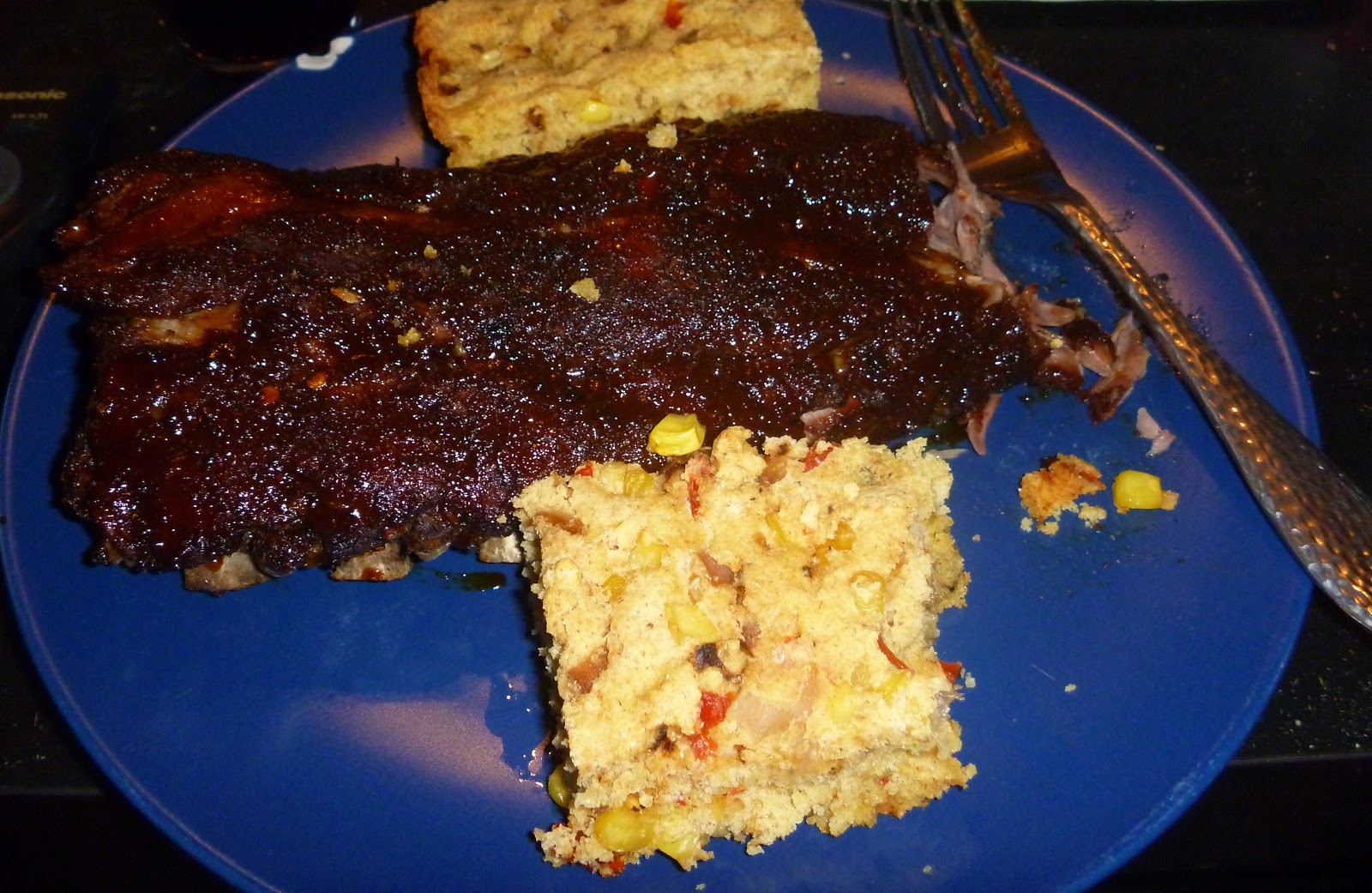
To bake the ribs, wrap them in foil and bake in a baking dish at 225 F for 4-5 hours. Remove foil and bake for another hour or so. Finally, about 10 minutes before serving, turn oven to broil, baste ribs with whatever BBQ sauce you like (I cheated and used store-bought) and broil until sauce is slightly caramelized.

So fall-off-the-bone tender that the cornbread is keeping it together!


Now, the result were fork-tender ribs (most tender I've ever made!) that tasted really good, but were missing that smoky flavour that is my life's blood. But all things considered, the convenience, ease, and warmth kind of make it a worthwhile way to cook ribs in colder times.

And there you have it, just a few ways you can take nature's most versatile meat and make it fit the season.
Hope you enjoy it!

Til next time!

Saturday, October 20, 2012

Travels in Taste - Joe Beef - Montreal

Howdy!

Sometimes a night out at a restaurant becomes more than just good meal, sometimes it's a divine experience. The right combination of food, service, decor and company can make a lifelong memory. The meal I had on September 15, 2012 at Joe Beef in Montreal's Little Burgundy definitely qualifies.

So, with a combination of pictures and words, let me tell you the tale of an epic culinary evening. To begin, let's set the scene: September 15 is the anniversary of when Kari and I decided to become a "couple" and it also happens to be the weekend of the Montreal Comic-Con. Needless to say, a trip to "La Belle Province" was warranted. As was making reservations about 2 months ahead of time...

Once we were in Montreal and it was close to dinner time, we walked up Rue Notre-Dame to the resto, taking in the cozy charm of the neighbourhood. Now, considering the reputation of the place, I kind of expected a bit more flash, but it was rather subdued in outside and interior decor. Well, the five seconds we saw of the interior before being sat on the terrasse.

Very unassuming, which is classy in itself


Beautiful dinner date!


Now then, whilst the interior was somewhat understated (lots of lovely wooden accents everywhere, but also quite snug and dimly-lit), the terrasse was perhaps one of the loveliest urban outdoor locales I've ever had the pleasure of seeing (and dining at). We had the fortune of being seated right at the end, next to the herb garden. Yup, they grow their own stuff at Joe Beef. As you'll see below, they had herbs a-plenty, but there were also cabbages and zucchini and all manner of veggie goodness growing behind where I was sitting. There was also a smoker (behind Kari's arm in the photo) that was in use, so the entire patio area smelled of smoke, herbs and rainbows (rainbows have a smell, right?).


The view whilst we dined. All those plants are ingredients used by the kitchen.

Needless to say, we were already in a great mood thanks to the natural splendour of the place, but what came next was far more exciting: THE MENU!

Now, most high-end restaurants these days (and maybe since always, but I haven't been eating in high-end joints for very long) don't have a fixed menu. They either print by the day/week or have the server read it out or whatever. Something that seems to be all the rage is the "blackboard menu", which makes sense to me. It gives an opportunity to constantly keep things interesting and keep customers coming back to try new things. It also gives people the chance to keep looking and thinking what they might get later, appetites permitting, or on their next visit, if they're lucky enough to have that same menu item available. Either way, the restaurant keeps the customers coming in.

In the case of Joe Beef, their menu was kind of mind-blowing. It was quite difficult to figure out what to pick. If you take the time to magnify the pic below, make sure you get a good look at all the offerings. It was REALLY hard to pick just one entree and one main dish.


The menu

I have to admit, I got kind of stuck figuring out what to order without some guidance from our server (whose name escapes a month after the fact... d'oh). At least for the entree part. The main was a no-brainer in my case, but more on that later.

After an explanation of a few items, my mind was pretty well made up. I ordered the Terrine de foie "Bone-in". This meant that the terrine (which was basically like a paté) was served on/in(?) a piece of bone that was cut in half, with the marrow removed (and then cooked into the terrine!!!!!)

My 1st plate - Terrine de foie "bone-in"

The verdict? Wow, just wow... The flavour of this dish instantly brought me back to childhood memories of my grandmaman's paté de foie gras, even though this was all pork (I think) while hers was either goose or, more often, chicken liver. The dish was also topped with a lovely assortment of pickled veggies that gave the whole thing a nice crunch and tang to offset the rich, velvety texture of the terrine, a richness that was doubly accentuated by the use of marrow. The bread was also quite tasty, but its main function was as meat vehicle. All in all, it was freakin' delicious.

As for Kari, she went for one of her favourites, gnocchi. In this case, it was a ricotta gnocchi served with pig skin and pecorino cheese.

Kari's 1st plate - Ricotta Gnocchi with pig skin and pecorino
I can't speak too much to the dish as I only had one bite (needed to save room for terrine goodness!), but I remember the tomato sauce was bright and fresh (they probably picked the tomatoes from their garden that morning!) and the pig skin had this chewiness that could have easily been off-putting, yet I found it fascinating and complex.

Of course with our first dishes came the wine! We went with a simple Burgundy red since there was a lot of meat in play and the food was far too rich for white. It was a delicious bottle of wine and really went well with all the food. So, kudos to our server (Justin or Julien maybe?) for picking a perfect accompaniment for 15 bucks less than my wine budget limit!


A lovely bottle of red to go with dinner.
And, since it was our anniversary dinner, I figured a little present for my favourite girl was also in order...


A little added bonus to the festivities
As we ate and drank and soaked in the awesomeness, the sunset decided to come along to provide the evening's visual entertainment!

Not a bad little view...

So, moving right along, it was time for the mains!

First we'll quickly talk about Kari's Pojarski de lapin "hot et délicieux". This was a riff on an old Quebec classic known as "hot chicken", which is essentially a shredded chicken sandwich smothered in gravy and peas. In this case, though, it was rabbit meat, minced and reformed Pojarski-style (Pojarski was a chef for Czar Nicholas I) and served on the bone. It too was smothered in gravy and peas, and pieces of chorizo, and God knows what else. It was rich, delicious goodness, but I'll admit I only had a quick bite so I don't quite remember how it tasted. I only had a quick bite because I needed to keep room in my belly for my main dish....


Kari's main: Pojarski de lapin "Hot et délicieux"

And now we come to one of the most decadent, rich, insane plates I've ever had the pleasure of not being able to finish.

Ladies and gentlemen, I give you Deer Belly. Yup, roll that factoid around your noodle. Deer. Belly.

As you may know, bacon comes from pork belly. That is the only time I've heard of an animal's"belly" meat being used in cooking (well, Haggis involves a sheep's stomach, but I think there's a difference between stomach and belly when it comes to butchery and cooking). I've had duck and lamb bacon, so they probably used the belly meat and I just discovered that "beef belly" is more commonly known as brisket! (thanks Interwebz!).

But DEER Belly?!?!?!? Who'd a thunk it! Well, the crazies in the Joe Beef kitchen, that's who! (either Chef David McMillan or Chef Frédéric Morin, I guess). Needless to say, I HAD to try that shizz out! Oh and as you might have seen from the menu picture, it came topped with escargots. Of course! In fact, it also was served with lovely Chanterelle mushrooms, cauliflower, jus, some kind of half-butter, half-potato mash. And then there were the pockets of garlic butter to round out the "bourguignone" style of the escargots. I peg this sucker well into the 4-digit calorie range.

So how did it taste? Oh my God... the drool, must stop drooling on keyboard... It was one of the most uniquely decadent dishes I've ever had. The belly itself was likely roasted then seared, so it had this great little crust on it. The meat was just a little gamy, as deer should be, and probably the densest meat I've ever had; dense, but not tough. And the accompanying medley of flavours from the snails, garlic, mushrooms and cauliflower made it a once-in-a-lifetime sort of dish.

It also made it incredibly filling. I tried as hard as I could, but I wasn't able to finish the last couple of bites. I felt foodie-shame, but at least I didn't rupture my tummy.


My main: Deer Belly w. escargots à la Bourguignone
Kari pretty much felt the same way I did by the end: So. Full.

In the end, we wound up walking back to our hotel room and passing into respective food comas.

Maybe we shouldn't have had Schwartz's for brunch that morning... Next time I go to Joe Beef (because I'm damn well going back), I'll make sure to eat only rice cakes beforehand...

So there you go! Another culinary escapade to Montreal! Luckily the next day involved walking around Comic-con all day, so at least some of the 8 billion calories were burned off...

Till next time, eat and cook better than you ever thought you could, because life's too short for crap food!
Cheers!


Saturday, October 6, 2012

The Pig in Autumn - Part 1

Hello again,

It's that most wonderful time of the year: Fall! Now's the time when our ursine side takes over and we start padding our midriffs with richer fare in preparation for that long hibernation period which is coming up in a couple of months. Well, at least it's hibernatory for those folks who choose not to have fun in the snow... Wimps.

All kidding aside, Fall cooking has got to me some of my favourite. No longer do I need to concern myself about the restrictions of heat and heaviness that makes eating rich food in the Summer time about as pleasant as punching yourself in the gut. It's also somehow a bit more acceptable to use the oven instead of the BBQ (not like the weather is that cold, but there's something pretty comforting in having the oven on for a few hours, warming up your home), while in Summer it's somehow blasphemous to NOT grill your food.

In Summer, for me, it's all about smoked pork, whether it's Ribs, Pulled Pork or Bacon, whatever... all of these have been important culinary undertakings for the past 3 months (including making enough pulled pork to feed a festival, sort of...). But now that I'm far less inclined to step outside (it's been raining A LOT this month), I'm looking for different ways to make use of pork and different ways to cook it, specifically indoors. So this and the next post will look at fun ways to make porky good times without having to step outside.

One way that Kari's been egging me to re-familiarize myself with is the slow cooker. A slow cooker is basically an electric element that heats a large ceramic container in which you put food and let it cook for several hours. The idea is that a) it is less time consuming because you just prep everything in one go, throw it in the cooker before heading to work and it's ready at dinnertime, and b) it allows tough cuts of meat to break down and become super-tender over the 'low and slow' period of several hours without having to keep a fire going.

So, I happened to have a hunk of heritage Berkshire pork shoulder sitting in the freezer (an impulse buy from the Farmer's Market) and I figured, even if it was the most expensive cut of pig I ever bought, it should go in the slow cooker and become something delicious. I was thinking something between a pulled pork and a stew, with a lot of wine and flavours that comfort the soul in cold weather (even though we were still in double digit weather at the time). Maybe I was jumping the gun, considering it was still technically Summer, but I figured it couldn't hurt to have a preview sampling of winter flavours.

And here's what I made!

Slow-cooker Wine-Braised Pork Shoulder

Serve LOTS!

- 4-5 lbs. bone-in pork shoulder
- 4-5 garlic cloves, minced
- 1 large onion, diced
- 2-3 celery ribs, chopped
- 2-3 carrots, chopped
- 2 potatoes, diced
- 1 cup red wine
- 1 tsp. thyme (dried or fresh)
- 1 tsp. rosemary (dried or fresh)
- 1/2 tsp. smoked paprika
- pinch of cinnamon
- pinch of nutmeg
- salt and pepper to taste

- Place all ingredients in slow cooker and cook on low for 6-8 hours.
- Skim layer of fat from slow cooker every 2 hours or so.
- Serve in a bowl with crusty bread.

My slow cooker: soon to become one of my best friends!
 
As time went on, the pork broke down beautifully into strings of tasty goodness. See for yourselves:

After 8 hours or so...

 The flavours came together into a stew reminiscent of Boeuf Bourguignon, which was the comforting, warming profile I was hoping for. Cook anything in enough wine and it'll be comforting! Served with a hunk of sourdough baguette and a cold beer, it was pretty much a slice of domestic heaven!

Not so much on the "light" side, but tasty and comforting as all get out!

Another serving application is to cook up some old-fashioned egg noodles (y'know, back before it was all called 'pasta') and serve the stew/ragu over top.

So, we've already got one way of cooking up pork that doesn't involve the smoker or grill. Next we'll look at our friend the oven, using both the stovetop (stew) and the oven itself (RIBS!).

'Til then, oink oink!